Calculator
Sheet metal weight calculator
Enter the material, the thickness and the size of a sheet or blank. The calculator gives the weight in kg and, with your price per kg, the material cost. Below it are the formula, the densities it uses and the weight of standard sheets in steel, stainless and aluminium.
| Standard sheet | Weight at 3.0 mm |
|---|---|
| 2000 × 1000 mm | 47.1 kg |
| 2500 × 1250 mm | 73.6 kg |
| 3000 × 1500 mm | 106.0 kg |
| 4000 × 1500 mm | 141.3 kg |
| 6000 × 2000 mm | 282.6 kg |
Weight = width × length × thickness × density. Densities are typical values; the price is a starting point, not a market price.
What to enter
| Field | Unit | What to enter |
|---|---|---|
| Material | S235, S355, 1.4301, 1.4404, AlMg3, copper, plywood, MDF or acrylic: the same list as the nester. Choose Other to enter a density yourself, for brass or pure aluminium. | |
| Density | g/cm³ | Filled in from the material. Change it if your supplier's data sheet gives another value. |
| Thickness | mm | The nominal thickness of the sheet. |
| Size | mm or m² | Width × length of the sheet or blank, or its area. |
| Quantity | count | The number of sheets or blanks of this size. |
| Price per kg | €/kg | Your supplier's price. It starts at the default for the material, labelled default until you change it. |
The result shows the weight per m², per piece and in total, and the material cost. The mm/in switch changes the units of thickness and size. The inputs are kept in the page address, so you can send a result to a colleague as a link.
How to calculate sheet weight
weight (kg) = area (m²) × thickness (mm) × density (g/cm³)
One square metre of sheet, 1 mm thick, is one litre of metal (1 dm³). A density in g/cm³ is the same number in kg/dm³, so it is also the weight in kg of one square metre at 1 mm. Steel at 7.85 g/cm³ weighs 7.85 kg per m² for every millimetre of thickness.
Example: a 1250 × 2500 mm sheet of 2 mm steel.
- Area: 1.25 m × 2.5 m = 3.125 m²
- Weight: 3.125 × 2 × 7.85 = 49.06 kg
The formula is the same for steel plate: 10 mm steel weighs 78.5 kg per m².
The result is the theoretical weight, worked out from the nominal thickness. A real sheet is heavier or lighter within its thickness tolerance. If an invoice depends on it, weigh one.
Density of sheet metals
| Material | Grade | Density in g/cm³ (= kg per m² at 1 mm) |
|---|---|---|
| Steel | S235, S355 | 7.85 |
| Stainless steel | 1.4301 (304) | 7.9 |
| Stainless steel | 1.4404 (316L) | 8.0 |
| Aluminium | AlMg3 (EN AW-5754) | 2.66 |
| Aluminium, pure | Al99.5 (EN AW-1050A) | 2.70 |
| Copper | Cu | 8.96 |
| Brass | CuZn37 and others | 8.4–8.7 |
- Nest&Quote uses the values for S235, S355, 1.4301, 1.4404, AlMg3 and copper in the nester and in this calculator, so both give the same weight.
- Pure aluminium and brass are not on the nester's material list. In the calculator, choose Other and enter the density.
- The density of brass depends on how much zinc and lead it contains, hence the range. Take the value from your supplier's data sheet.
Weight per square metre by thickness
Weights in kg per m².
| Thickness | Steel S235, S355 | Stainless 1.4301 | Stainless 1.4404 | Aluminium AlMg3 | Copper |
|---|---|---|---|---|---|
| 0.8 mm | 6.28 | 6.32 | 6.40 | 2.13 | 7.17 |
| 1 mm | 7.85 | 7.90 | 8.00 | 2.66 | 8.96 |
| 1.5 mm | 11.78 | 11.85 | 12.00 | 3.99 | 13.44 |
| 2 mm | 15.70 | 15.80 | 16.00 | 5.32 | 17.92 |
| 2.5 mm | 19.63 | 19.75 | 20.00 | 6.65 | 22.40 |
| 3 mm | 23.55 | 23.70 | 24.00 | 7.98 | 26.88 |
| 4 mm | 31.40 | 31.60 | 32.00 | 10.64 | 35.84 |
| 5 mm | 39.25 | 39.50 | 40.00 | 13.30 | 44.80 |
| 6 mm | 47.10 | 47.40 | 48.00 | 15.96 | 53.76 |
| 8 mm | 62.80 | 63.20 | 64.00 | 21.28 | 71.68 |
| 10 mm | 78.50 | 79.00 | 80.00 | 26.60 | 89.60 |
| 12 mm | 94.20 | 94.80 | 96.00 | 31.92 | 107.52 |
| 15 mm | 117.75 | 118.50 | 120.00 | 39.90 | 134.40 |
| 20 mm | 157.00 | 158.00 | 160.00 | 53.20 | 179.20 |
Weight per standard sheet
Sheet sizes in mm, weights in kg, theoretical.
Steel sheet (S235, S355, 7.85 g/cm³)
| Thickness | 1000 × 2000 | 1250 × 2500 | 1500 × 3000 | 2000 × 4000 |
|---|---|---|---|---|
| 1 mm | 15.7 | 24.5 | 35.3 | 62.8 |
| 1.5 mm | 23.6 | 36.8 | 53.0 | 94.2 |
| 2 mm | 31.4 | 49.1 | 70.7 | 125.6 |
| 3 mm | 47.1 | 73.6 | 106.0 | 188.4 |
| 4 mm | 62.8 | 98.1 | 141.3 | 251.2 |
| 5 mm | 78.5 | 122.7 | 176.6 | 314.0 |
| 6 mm | 94.2 | 147.2 | 212.0 | 376.8 |
| 8 mm | 125.6 | 196.3 | 282.6 | 502.4 |
| 10 mm | 157.0 | 245.3 | 353.3 | 628.0 |
| 12 mm | 188.4 | 294.4 | 423.9 | 753.6 |
| 15 mm | 235.5 | 368.0 | 529.9 | 942.0 |
| 20 mm | 314.0 | 490.6 | 706.5 | 1,256.0 |
Stainless steel sheet (1.4301, 7.9 g/cm³)
| Thickness | 1000 × 2000 | 1250 × 2500 | 1500 × 3000 | 2000 × 4000 |
|---|---|---|---|---|
| 1 mm | 15.8 | 24.7 | 35.6 | 63.2 |
| 1.5 mm | 23.7 | 37.0 | 53.3 | 94.8 |
| 2 mm | 31.6 | 49.4 | 71.1 | 126.4 |
| 3 mm | 47.4 | 74.1 | 106.7 | 189.6 |
| 4 mm | 63.2 | 98.8 | 142.2 | 252.8 |
| 5 mm | 79.0 | 123.4 | 177.8 | 316.0 |
| 6 mm | 94.8 | 148.1 | 213.3 | 379.2 |
| 8 mm | 126.4 | 197.5 | 284.4 | 505.6 |
| 10 mm | 158.0 | 246.9 | 355.5 | 632.0 |
Aluminium sheet (AlMg3, 2.66 g/cm³)
| Thickness | 1000 × 2000 | 1250 × 2500 | 1500 × 3000 | 2000 × 4000 |
|---|---|---|---|---|
| 1 mm | 5.3 | 8.3 | 12.0 | 21.3 |
| 1.5 mm | 8.0 | 12.5 | 18.0 | 31.9 |
| 2 mm | 10.6 | 16.6 | 23.9 | 42.6 |
| 3 mm | 16.0 | 24.9 | 35.9 | 63.8 |
| 4 mm | 21.3 | 33.3 | 47.9 | 85.1 |
| 5 mm | 26.6 | 41.6 | 59.9 | 106.4 |
| 6 mm | 31.9 | 49.9 | 71.8 | 127.7 |
| 8 mm | 42.6 | 66.5 | 95.8 | 170.2 |
| 10 mm | 53.2 | 83.1 | 119.7 | 212.8 |
Inch sheets: 4 × 8 ft is 1219 × 2438 mm, or 2.972 m². 5 × 10 ft is 1524 × 3048 mm, or 4.645 m². In 3 mm steel they weigh 70.0 kg and 109.4 kg. For another thickness, multiply the area by the weight per m² in the table above.
From weight to material cost
material cost = weight (kg) × price per kg
One 1500 × 3000 mm sheet of 3 mm S235: 4.5 m² × 3 × 7.85 = 105.975 kg. At €1.10 per kg, the default price for S235 in Nest&Quote and in this calculator, the sheet costs €116.57. The default is a starting point, not a market price. Use the price on your supplier's last invoice.
If your supplier prices by the sheet, divide the sheet price by the weight in the table. That gives a price per kg you can compare.
Material is one line of a quote. Cutting, the machine time at your hourly rate, is another: cut-time calculator. And for the material line, the weight of one sheet is rarely the question. What counts is how much steel the job uses.
Part weight is not the steel a job uses
A part's own weight, its area × thickness × density, leaves out the steel around it: the part gaps, the edge margin, the skeleton between the parts and the rest of the last sheet. You buy that steel too. How much of it a job uses comes from the nest.
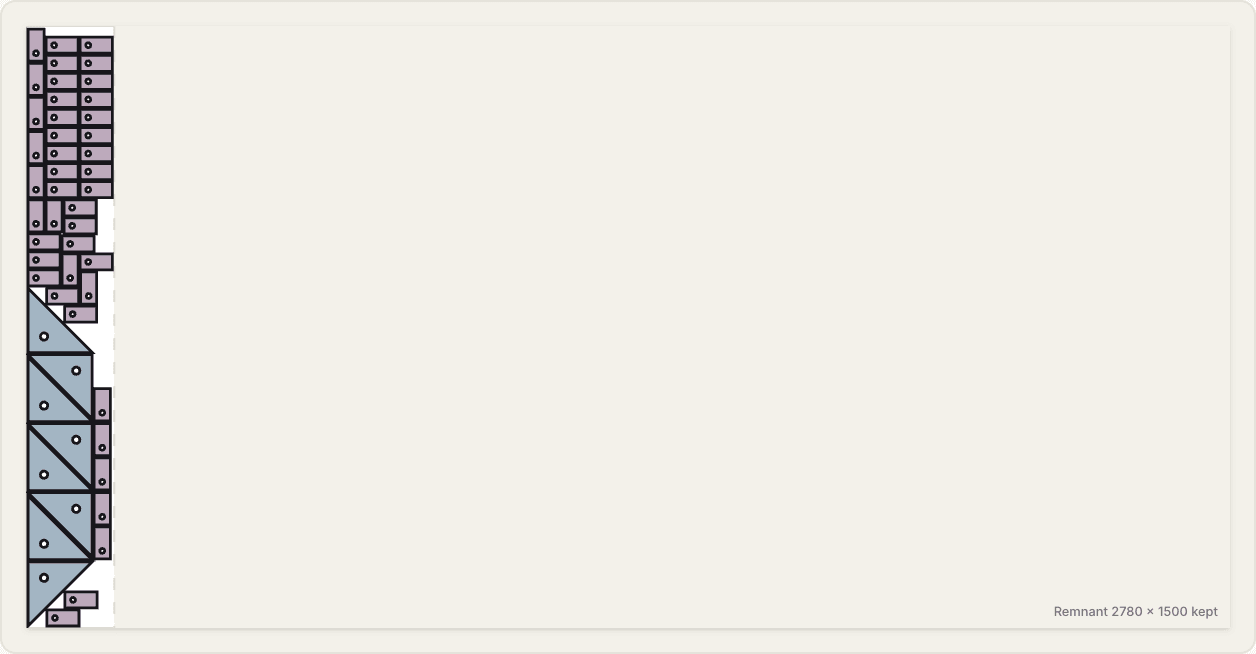
The bracket set in the demo shows the difference: 202 parts in 3 mm S235, nested on two 1500 × 3000 mm sheets.
| Area | Weight | At €1.10 per kg | |
|---|---|---|---|
| The parts on their own | 3.849 m² | 90.6 kg | €99.71 |
| Steel consumed: one full sheet and the used length of the second | 4.773 m² | 112.4 kg | €123.64 |
| Two full sheets | 9.000 m² | 212.0 kg | €233.15 |
- The parts are 80.6 % of the steel consumed. That is the material utilisation the result shows.
- Priced from the parts' own weight, the material line would miss 21.8 kg of steel, €23.94 at this price.
- The difference to two full sheets, 99.6 kg, is the rest of the second sheet. The nest shows it as a remnant, with its size, so you can see it before you decide whether to charge it to the job.
Take the weight of a whole job from the nest
Upload the DXF drawings of a job, one part per file, and enter the sheet sizes you stock. Nest&Quote nests the job on each size and keeps the one that uses the least steel. It works in the browser: DXF in, cut files out.
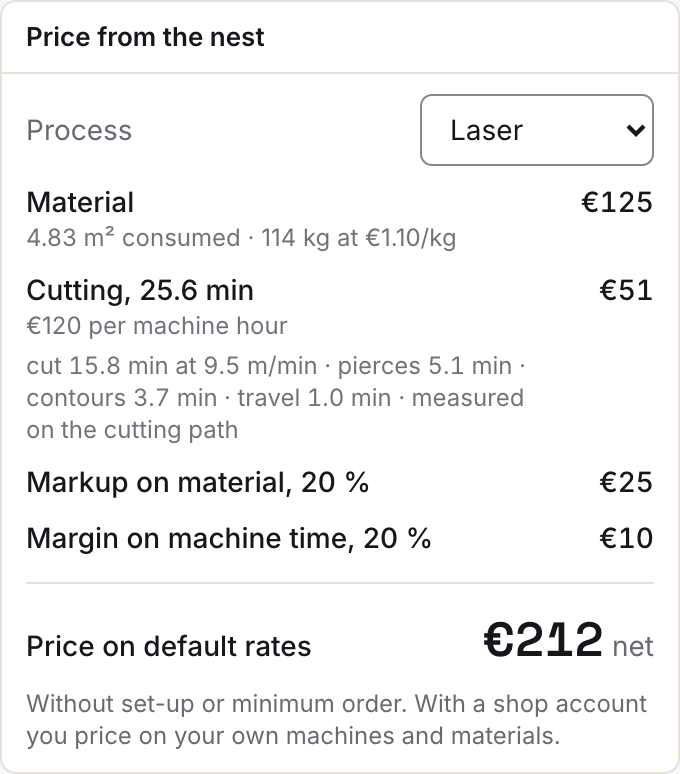
The "Price from the nest" panel in the result gives the steel consumed in m² and kg, with the same densities as this calculator, and prices it at the default price per kg. With an account, you set your own price per kg, and add your own materials, on the Rates page.
Questions
How much does 1 m² of 1 mm steel weigh?
7.85 kg. Each further millimetre adds another 7.85 kg: 3 mm steel weighs 23.55 kg per m², 10 mm steel 78.5 kg.
How do I work out the weight of a steel sheet by hand?
Multiply the area in m² by the thickness in mm and by 7.85. A 1500 × 3000 mm sheet in 5 mm: 4.5 × 5 × 7.85 = 176.6 kg.
Which density should I use for aluminium, 2.70 or 2.66?
Pure aluminium is 2.70 g/cm³. AlMg3 (EN AW-5754), a common sheet alloy, is 2.66. The difference is about 1.5 %: a 1500 × 3000 mm sheet in 3 mm weighs 36.5 kg at 2.70 and 35.9 kg at 2.66.
Which density should I use for stainless, 7.9 or 8.0?
7.9 g/cm³ for 1.4301 (304), 8.0 for 1.4404 (316L). A 1500 × 3000 mm sheet in 3 mm weighs 106.7 kg in 1.4301 and 108.0 kg in 1.4404.
Does galvanising change the weight?
A little. The zinc coating is specified by its mass: Z275 means 275 g of zinc per m² of sheet, both sides together. On 1 mm steel that adds 0.275 kg to the 7.85 kg per m², about 3.5 %. For galvanised sheet, add the coating mass to the result.
Does it work for plywood, MDF or acrylic?
Yes. The material list has them at 0.65 g/cm³ for plywood, 0.75 for MDF and 1.19 for acrylic. Plywood varies with the wood and the glue, so if the weight matters, weigh a sheet and enter your own density.
How do I turn the weight into the material line of a quote?
Multiply the steel the job consumes, in kg, by your price per kg. The steel consumed comes from the nest: the full sheets plus the used length of the last one. How Nest&Quote prices each line from the nest: quoting.
Check it against steel you have already used
Nest the drawings of a job you have cut. Compare the steel consumed with what you took from the rack for it.